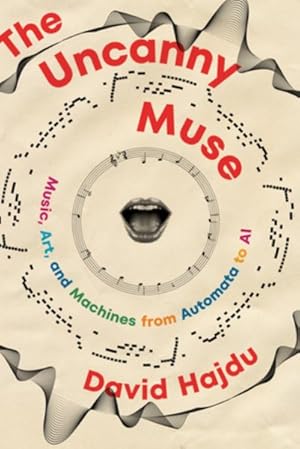
The Uncanny Muse
Music, Art, and Machines from Automata to AI
David Hajdu
An acclaimed critic, journalist, and songwriter-musician tells the story of art’s relation to machines, from the Baroque period to the age of AI.
What does it mean to be human in a world where machines, too, can be artists? The Uncanny Muse explores the history of automation in the arts and delves into one of the most momentous and controversial aspects of AI: artificial creativity. The adoption of technology and machinery has long transformed the world, but as the potential for artificial intelligence expands, David Hajdu examines the new, increasingly urgent questions about technology’s role in culture.
From the life-size mechanical doll that made headlines in Victorian London to the doll’s modern AI–pop star counterpart, Hajdu traces the fascinating, varied ways in which inventors and artists have sought to emulate mental processes and mechanize creative production. For decades, machines and artists have engaged in expressing the human condition—along with the condition of living with machines—through player pianos, broadcasting technology, electric organs, digital movie effects, synthesizers, and motion capture. By communicating and informing human knowledge, the machines have exerted considerable influence on the history of art—and often more influence than humans have been willing to recognize. As Hajdu proclaims: “before machine learning, there was machine teaching.”
With thoughtful, wide-ranging, and surprising turns from Berry Gordy and George Harrison to Andy Warhol and Stevie Wonder, David Hajdu takes a novel and contrarian approach: he sees how machines through the ages have enabled creativity, not stifled it—and The Uncanny Muse sees no reason why this shouldn’t be the case with AI today.
Original: $32.99
-65%$32.99
$11.55Product Information
Product Information
Shipping & Returns
Shipping & Returns
Description
Music, Art, and Machines from Automata to AI
David Hajdu
An acclaimed critic, journalist, and songwriter-musician tells the story of art’s relation to machines, from the Baroque period to the age of AI.
What does it mean to be human in a world where machines, too, can be artists? The Uncanny Muse explores the history of automation in the arts and delves into one of the most momentous and controversial aspects of AI: artificial creativity. The adoption of technology and machinery has long transformed the world, but as the potential for artificial intelligence expands, David Hajdu examines the new, increasingly urgent questions about technology’s role in culture.
From the life-size mechanical doll that made headlines in Victorian London to the doll’s modern AI–pop star counterpart, Hajdu traces the fascinating, varied ways in which inventors and artists have sought to emulate mental processes and mechanize creative production. For decades, machines and artists have engaged in expressing the human condition—along with the condition of living with machines—through player pianos, broadcasting technology, electric organs, digital movie effects, synthesizers, and motion capture. By communicating and informing human knowledge, the machines have exerted considerable influence on the history of art—and often more influence than humans have been willing to recognize. As Hajdu proclaims: “before machine learning, there was machine teaching.”
With thoughtful, wide-ranging, and surprising turns from Berry Gordy and George Harrison to Andy Warhol and Stevie Wonder, David Hajdu takes a novel and contrarian approach: he sees how machines through the ages have enabled creativity, not stifled it—and The Uncanny Muse sees no reason why this shouldn’t be the case with AI today.