🎉 Up to 70% Off Selected ItemsShop Sale
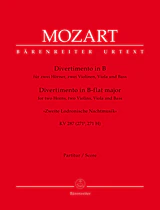
Mozart Divertimento for 2 Horns, 2 Violins, Viola and Bass in B-flat major K 287
Mozart composed his two “Lodron Serenades” for open-air performances on the name day of Countess Antonia Lodron in June 1776 and 1777. Their bright “al fresco” character is immediately recognisable. Alfred Einstein considered these two divertimentos to be “among the purest, gayest, most satisfying, and most perfect that ever assumed musical form”.
For both works Mozart chose an ensemble of two horns, two violins, viola and bass instruments. However, the second Lodron Serenade, the Divertimento in B-flat major K. 287, stands out from this sextet format by assigning a remarkably virtuosic solo role to the first violin, from the richly diverse opening movement to the finale with its almost ironic recitative and an exhilarating passage on the folk song “D’Bäurin hat d’Katz verlorn”. Mozart himself played first violin in the 1777 performance. Later he wrote, “They all opened their eyes! I played as though I were the finest fiddler in all Europe”.
For both works Mozart chose an ensemble of two horns, two violins, viola and bass instruments. However, the second Lodron Serenade, the Divertimento in B-flat major K. 287, stands out from this sextet format by assigning a remarkably virtuosic solo role to the first violin, from the richly diverse opening movement to the finale with its almost ironic recitative and an exhilarating passage on the folk song “D’Bäurin hat d’Katz verlorn”. Mozart himself played first violin in the 1777 performance. Later he wrote, “They all opened their eyes! I played as though I were the finest fiddler in all Europe”.
$27.09
Mozart Divertimento for 2 Horns, 2 Violins, Viola and Bass in B-flat major K 287—
$27.09
Product Information
Product Information
Shipping & Returns
Shipping & Returns
Description
Mozart composed his two “Lodron Serenades” for open-air performances on the name day of Countess Antonia Lodron in June 1776 and 1777. Their bright “al fresco” character is immediately recognisable. Alfred Einstein considered these two divertimentos to be “among the purest, gayest, most satisfying, and most perfect that ever assumed musical form”.
For both works Mozart chose an ensemble of two horns, two violins, viola and bass instruments. However, the second Lodron Serenade, the Divertimento in B-flat major K. 287, stands out from this sextet format by assigning a remarkably virtuosic solo role to the first violin, from the richly diverse opening movement to the finale with its almost ironic recitative and an exhilarating passage on the folk song “D’Bäurin hat d’Katz verlorn”. Mozart himself played first violin in the 1777 performance. Later he wrote, “They all opened their eyes! I played as though I were the finest fiddler in all Europe”.
For both works Mozart chose an ensemble of two horns, two violins, viola and bass instruments. However, the second Lodron Serenade, the Divertimento in B-flat major K. 287, stands out from this sextet format by assigning a remarkably virtuosic solo role to the first violin, from the richly diverse opening movement to the finale with its almost ironic recitative and an exhilarating passage on the folk song “D’Bäurin hat d’Katz verlorn”. Mozart himself played first violin in the 1777 performance. Later he wrote, “They all opened their eyes! I played as though I were the finest fiddler in all Europe”.