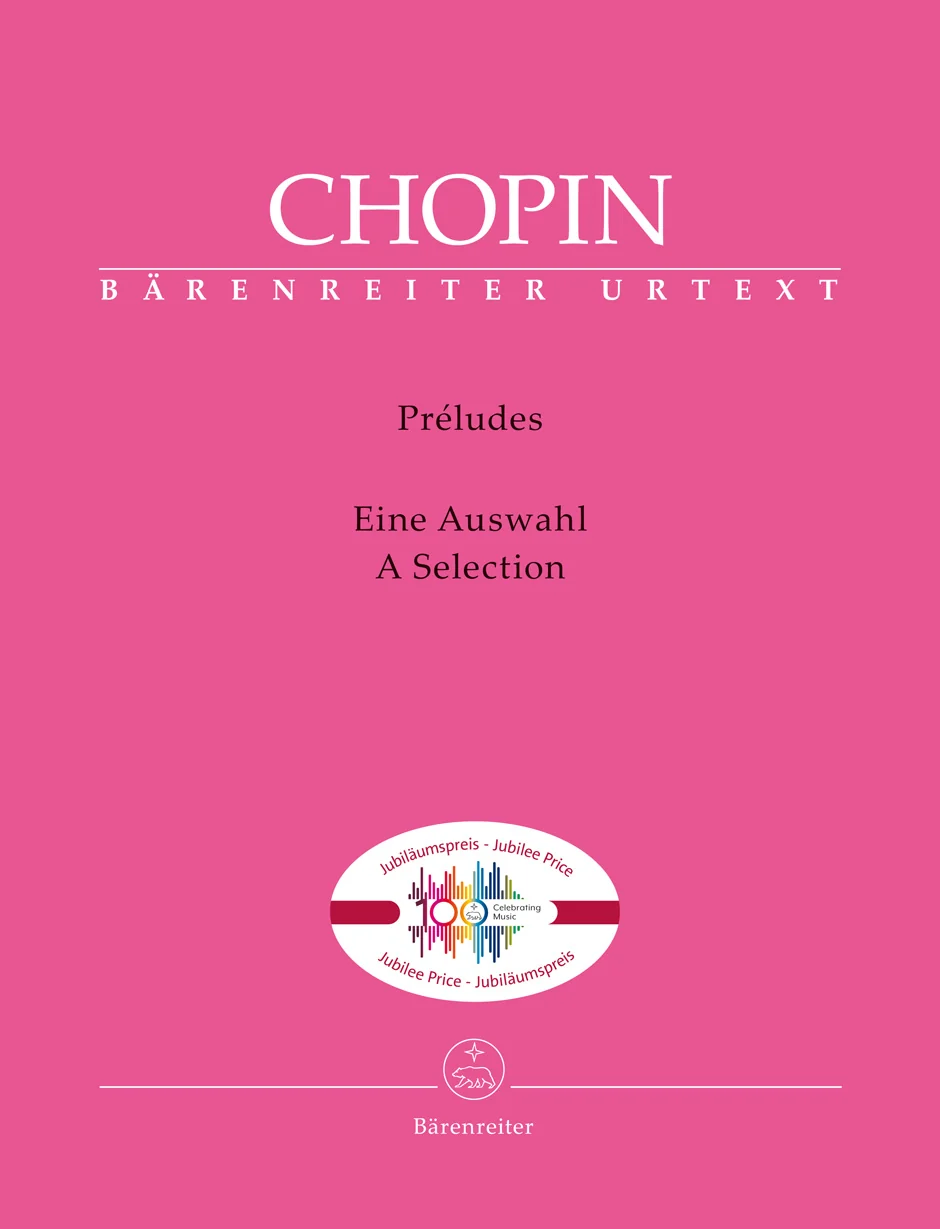
Chopin Selected Preludes
Chopin’s name is forevermore connected with the piano. He was a fabulous pianist, improviser, and, of course, composer with a very unique, personal style that is characterized by a sense of rubato, allusions to Polish folk music, grace and melancholy contrasted by virtuosity, pride and herioc gestures. No other cycle of works wields such an appeal as his "Préludes op. 28". He completed them shortly before his 29th birthday, while spending a winter in Mallorca with George Sand and her children.
This collection of nine "Préludes" appears as part of a series of popular works from the Bärenreiter catalogue celebrating the 100th anniversary of the publishing house. The complete Urtext edition of the "Préludes op. 28", which includes the "Prélude op. 45" (BA09610), offers Chopin's own fingerings and those of his pupils as well as supplementary historically-informed fingerings and notes on historical performance practice, specifically on the use of the pedal, ornamentation, "finger pedaling”, latent polyphony (cantilena), dynamics, rubato and tempo.
Contents
Original: $3.95
-65%$3.95
$1.38Product Information
Product Information
Shipping & Returns
Shipping & Returns
Description
Chopin’s name is forevermore connected with the piano. He was a fabulous pianist, improviser, and, of course, composer with a very unique, personal style that is characterized by a sense of rubato, allusions to Polish folk music, grace and melancholy contrasted by virtuosity, pride and herioc gestures. No other cycle of works wields such an appeal as his "Préludes op. 28". He completed them shortly before his 29th birthday, while spending a winter in Mallorca with George Sand and her children.
This collection of nine "Préludes" appears as part of a series of popular works from the Bärenreiter catalogue celebrating the 100th anniversary of the publishing house. The complete Urtext edition of the "Préludes op. 28", which includes the "Prélude op. 45" (BA09610), offers Chopin's own fingerings and those of his pupils as well as supplementary historically-informed fingerings and notes on historical performance practice, specifically on the use of the pedal, ornamentation, "finger pedaling”, latent polyphony (cantilena), dynamics, rubato and tempo.
Contents